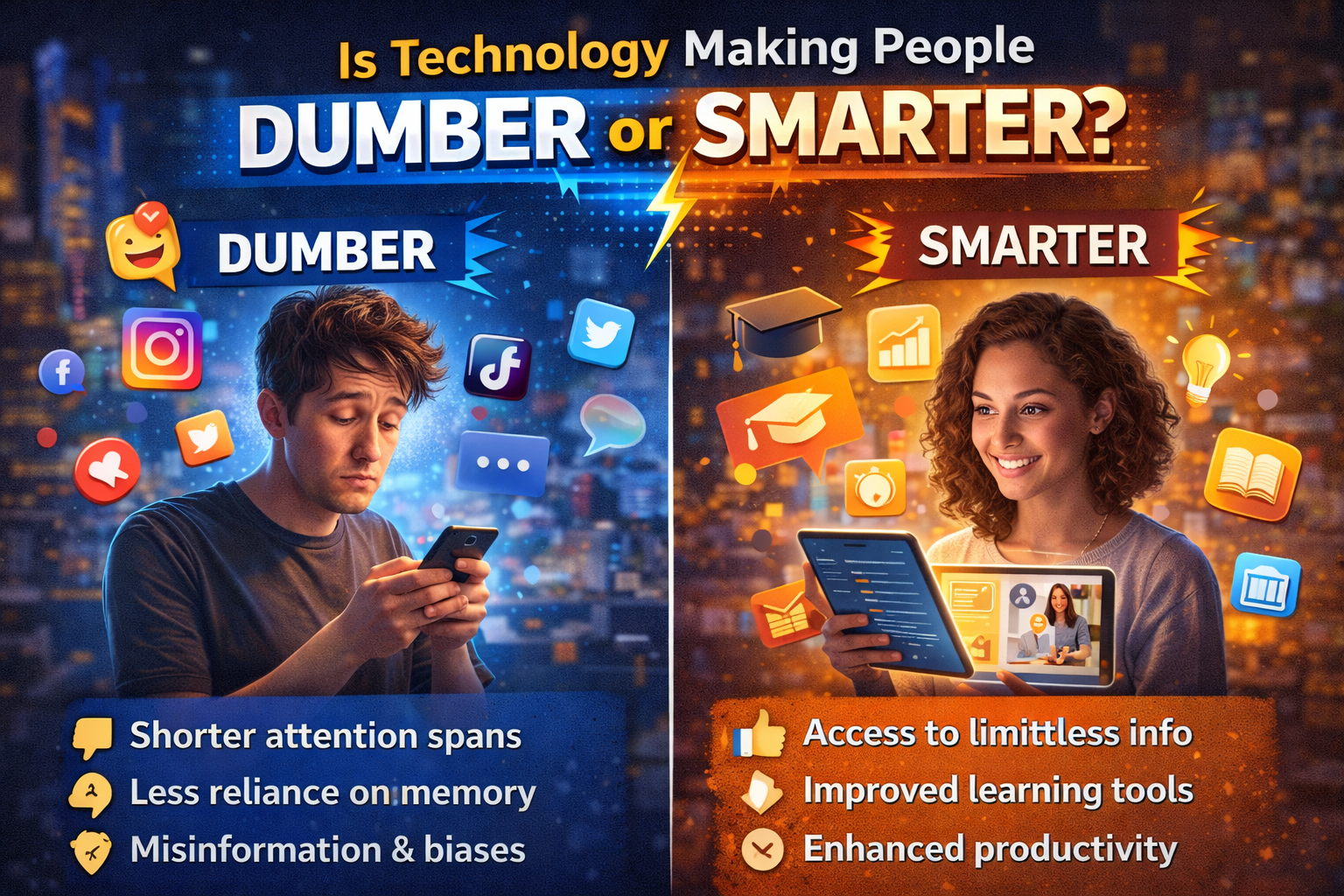

In an era defined by rapid technological advancements, a pervasive question lingers: is technology making people dumber or smarter? As we navigate 2026, our lives are more intertwined with digital tools than ever before, from artificial intelligence assistants to ubiquitous smartphones. This integration brings both incredible opportunities for intellectual growth and concerning challenges to cognitive function. This article delves into the complex relationship between technology and human intelligence, exploring the arguments for both enhancement and detriment, and offering insights into how we can harness technology to truly thrive.
Key Takeaways
- Technology provides unparalleled access to information and learning tools, potentially enhancing cognitive abilities and problem-solving skills.
- Risks like cognitive offloading, reduced attention spans, and over-reliance on external processing pose threats to deep thinking and memory.
- The impact of technology is highly dependent on individual usage patterns and the societal frameworks encouraging mindful engagement.
- Artificial Intelligence (AI) can serve as a powerful augmented intelligence tool, freeing up human capacity for higher-level creative and strategic thought, but requires careful integration.
- Cultivating digital mindfulness and critical thinking skills is crucial to leveraging technology for smarter outcomes in 2026 and beyond.
The “Smarter” Argument: How Technology Boosts Our Brainpower
The proponents of technology’s positive impact argue that it unequivocally makes us smarter, providing unprecedented access to knowledge and tools for intellectual expansion. This perspective emphasizes how digital advancements have democratized information and offered new avenues for learning and problem-solving.
Anyone researching making people dumber may also want to understand liquid unlocking flow 2026 before deciding on the best option.
Access to Information and Learning 📚
Never before has humanity had such immediate access to vast quantities of information. A few taps on a smartphone can bring up encyclopedic knowledge, academic papers, tutorials, and diverse perspectives from around the globe. This instant accessibility facilitates learning and research, enabling individuals to quickly acquire new skills or deepen existing knowledge.
- Democratization of Knowledge: Educational resources, once exclusive, are now available to billions.
- Personalized Learning: AI-driven educational platforms adapt to individual learning styles and paces, offering tailored experiences that optimize knowledge retention.
- Skill Acquisition: Online courses, interactive simulations, and virtual reality training environments make complex skills more accessible to learn.
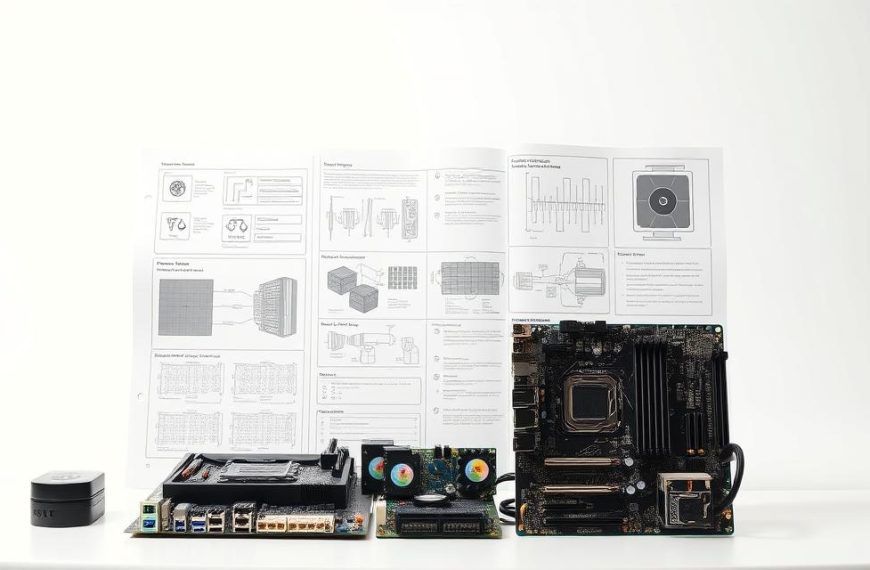
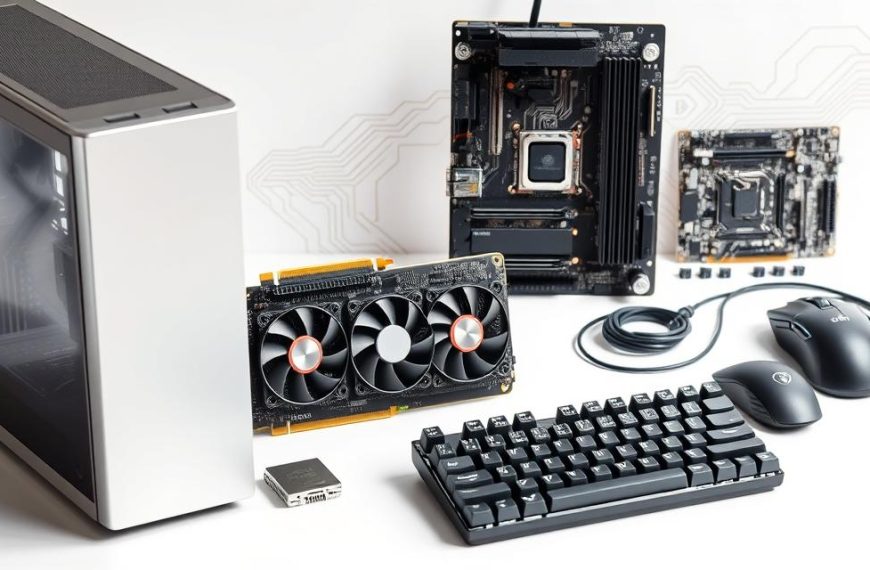
For example, someone looking to understand the intricacies of computer hardware components can find detailed guides and videos online, learning at their own pace. This capability truly exemplifies how technology empowers individuals to become lifelong learners.
Enhanced Problem-Solving and Creativity 💡
Technology provides powerful tools that extend our problem-solving capabilities and foster creativity. From advanced calculators and data analysis software to graphic design tools and AI-powered creative assistants, these resources augment human intellect.
- Data Analysis: Complex datasets can be processed and visualized in moments, revealing patterns and insights that would be impossible to discern manually. This is particularly relevant in fields like business, where leveraging AI can optimize business processes for maximum efficiency.
- Simulation and Modeling: Engineers, scientists, and designers use technology to simulate real-world scenarios, testing hypotheses and iterating on designs faster and more cost-effectively.
- Creative Expression: Digital art studios, music production software, and video editing tools lower the barrier to entry for creative pursuits, allowing more people to express themselves and innovate.
“Technology, when wielded thoughtfully, transforms from a mere tool into a true extension of our cognitive abilities, enabling us to think bigger, deeper, and more creatively than ever before.”
Augmented Intelligence and AI Integration 🤖
Perhaps the most compelling argument for technology making us smarter, especially in 2026, comes from the rise of Artificial Intelligence. AI is not just automating tasks; it’s augmenting human intelligence by processing information, identifying patterns, and making recommendations at speeds far beyond human capacity. Understanding the future impact of AI on business clearly illustrates this augmentation.
| AI Role | How it Makes Us Smarter |
|---|---|
| Information Synthesis | Processes vast amounts of data, summarizes key points, and identifies trends, allowing humans to grasp complex topics faster. |
| Problem Identification | Detects anomalies and predicts potential issues before they become critical, enabling proactive problem-solving. |
| Personalized Assistance | Acts as a personal tutor or research assistant, guiding users through complex subjects and improving learning efficiency. |
| Creative Generation | Generates ideas, drafts content, or creates design variations, serving as a springboard for human creativity. |
When AI is used as a collaborative partner, as discussed in how leveraging AI to improve your business can lead to breakthroughs, it allows individuals to focus on higher-level strategic thinking, innovation, and creative problem-solving rather than rote tasks.
The “Dumber” Argument: How Technology Can Undermine Cognition
Despite the undeniable benefits, concerns persist that technology, if misused or overused, could be making people dumber. Critics point to several cognitive downsides that emerge from our increasing reliance on digital devices and platforms.
Cognitive Offloading and Memory Decline 🧠⬇️
One of the primary concerns is cognitive offloading – the tendency to rely on external devices to perform mental tasks previously done internally. Why remember a phone number or a fact when a search engine or contact list is instantly available? While efficient, this practice can lead to a decline in certain cognitive functions, particularly memory.
- Reduced Working Memory: Constantly switching between tasks and relying on external memory aids can weaken our internal working memory capacity.
- “Google Effect”: Studies suggest that people remember less specific information but remember where to find that information online.
- Decreased Mental Effort: If we always choose the path of least resistance by letting technology do the heavy lifting, our brains may adapt by expending less effort on complex thought.
Shorter Attention Spans and Superficial Learning 📉
The constant stream of notifications, endless content feeds, and the culture of instant gratification fostered by technology are often cited as culprits behind shorter attention spans. This can hinder deep learning and critical analysis.
- Multitasking Myth: While we might feel productive, constant task-switching reduces efficiency and the ability to focus deeply on a single subject.
- “Skim Reading”: The habit of quickly scanning web pages leads to superficial comprehension rather than in-depth understanding.
- Dependence on Summaries: A reliance on simplified summaries or short videos can prevent individuals from engaging with complex original texts and developing their own analytical skills.
Erosion of Critical Thinking and Social Skills 🗣️❌
When answers are readily available, the process of critical inquiry and independent thought can sometimes be sidestepped. Furthermore, increased digital interaction at the expense of face-to-face communication can impact social intelligence.
- Echo Chambers: Algorithms often show us content that aligns with our existing beliefs, creating intellectual echo chambers that stifle exposure to diverse perspectives and critical debate.
- Information Overload: The sheer volume of data can make it difficult to distinguish reliable information from misinformation, requiring a higher degree of information literacy.
- Reduced Empathy: Digital communication can lack the non-verbal cues essential for developing empathy and understanding complex social dynamics.
The Nuance: It’s Not Black and White for “Is Technology Making People Dumber or Smarter”
The question of is technology making people dumber or smarter doesn’t have a simple yes or no answer. The reality is far more nuanced, depending heavily on how individuals interact with technology and the intentionality behind that interaction. Technology is a tool, and like any tool, its impact is determined by its user.
The Importance of Intentional Engagement ✅
Those who approach technology with an active, critical mindset are more likely to reap its intellectual benefits. This involves using digital tools to:
- Seek Diverse Information: Actively look for different viewpoints and critically evaluate sources.
- Engage in Deep Learning: Use technology for in-depth research, complex problem-solving, and skill development, not just passive consumption.
- Collaborate and Create: Leverage digital platforms for collaborative projects and creative expression.
- Practice Digital Mindfulness: Be aware of screen time and its impact on mental well-being and focus.
Education and Digital Literacy in 2026 🏫
In 2026, education systems play a vital role in shaping how future generations interact with technology. Teaching digital literacy – the ability to find, evaluate, create, and communicate information online – is paramount. This includes understanding the biases in algorithms and the importance of cybersecurity.
For example, just as we learn about how PC memory impacts performance, it’s equally important to understand how digital habits impact our cognitive performance.
The Role of Artificial Intelligence (AI) in Shaping Intelligence
The ongoing evolution of AI is a game-changer in this debate. AI offers the potential for unprecedented cognitive augmentation, assisting in tasks from complex data analysis to language translation. However, it also brings the risk of over-reliance, where human critical faculties might atrophy if not actively maintained. The key is to view AI as ‘augmented intelligence’ – a partner, not a replacement. Strategies for integrating AI into your business often emphasize this collaborative approach.
Strategies for Using Technology to Become Smarter
Given the dual nature of technology’s impact, proactive strategies are essential for individuals and societies to ensure that technology serves to enhance, rather than diminish, human intelligence.
Cultivate Active Learning Habits 📚➕
- Engage, Don’t Just Consume: Use platforms for creating, discussing, and problem-solving.
- Seek Variety: Explore different types of content – articles, documentaries, podcasts, interactive courses.
- Follow Curiosity: Leverage the internet to deep-dive into subjects that genuinely interest you, fostering intrinsic motivation for learning.
Practice Digital Wellness and Mindfulness 🧘♀️📱
- Scheduled Breaks: Implement regular breaks from screens.
- Notifications Control: Turn off non-essential notifications to reduce distractions.
- Mindful Consumption: Ask yourself *why* you’re reaching for your device. Is it for a specific purpose or just out of habit?
- Limit Multitasking: Focus on one task at a time to improve concentration and comprehension.
Develop Critical Information Literacy Skills 🤔🔍
- Source Verification: Always question the origin and credibility of information found online.
- Bias Awareness: Understand that all information can have biases, including algorithmic biases in search results or social media feeds.
- Fact-Checking: Utilize fact-checking websites and cross-reference information from multiple reputable sources.
FAQ: Is Technology Making People Dumber or Smarter?
How to Balance Technology Use for Cognitive Enhancement in 2026
Key Terms: Technology and Intelligence
Conclusion: Steering Towards a Smarter Future in 2026
The question of is technology making people dumber or smarter ultimately depends on us. In 2026, technology is neither inherently good nor bad for human intelligence; it is a powerful amplifier of our intentions and habits. When embraced with thoughtfulness and intentionality, digital tools, especially the rapidly evolving capabilities of AI, can unlock unprecedented cognitive potential, enabling us to learn more, solve complex problems, and foster creativity at a scale previously unimaginable.
However, the risks of cognitive offloading, diminished attention spans, and an erosion of critical thinking are real and require conscious mitigation. The path to a smarter future in the digital age involves cultivating digital mindfulness, developing robust critical information literacy, and actively choosing to use technology for augmentation rather than simple replacement of our innate cognitive functions. By doing so, we can ensure that the technological revolution serves to elevate, rather than diminish, the human intellect.
Actionable Next Steps:
- Evaluate Your Tech Habits: Conduct a ‘digital audit’ of your daily tech usage. Identify areas where you can shift from passive consumption to active learning or creation.
- Invest in Digital Literacy: Seek out resources or courses to improve your critical evaluation of online information and understanding of AI.
- Set Boundaries: Establish clear boundaries for screen time and device usage, especially during critical thinking tasks or social interactions.
- Embrace AI as an Assistant: Learn how to leverage AI tools to enhance your productivity and problem-solving, but always apply your own critical judgment to its outputs. For instance, exploring using AI to generate a business plan could be a starting point for leveraging AI as an assistant rather than a full replacement for strategic thought.
- Prioritize Offline Engagement: Actively seek out real-world experiences, face-to-face conversations, and hobbies that don’t involve screens to maintain a balanced and well-rounded cognitive life.

 By
By