
The rapid evolution of Artificial Intelligence (AI) has sparked both excitement and apprehension across the business landscape. While visions of sentient machines often dominate popular culture, the reality for most enterprises in 2026 lies not in hypothetical super-intelligence, but in the practical, focused capabilities of “weak AI.” Understanding what does weak AI mean in business is crucial for any organization looking to leverage this technology effectively, differentiate itself from competitors, and drive tangible growth. This article will delve into the core concepts of weak AI, its practical applications, strategic advantages, and the considerations businesses must address to harness its full potential.
Key Takeaways
- Weak AI, also known as Narrow AI, is designed for specific tasks and operates within predefined parameters, unlike hypothetical general AI.
- It powers many everyday business tools from chatbots and recommendation engines to predictive analytics and automation software.
- Businesses leverage weak AI to enhance efficiency, reduce costs, improve customer experience, and gain data-driven insights.
- Successful integration requires clear objectives, quality data, ethical considerations, and a focus on augmenting human capabilities.
- Ignoring weak AI in 2026 can lead to competitive disadvantages, as it’s becoming a fundamental component of modern operational strategies.
Demystifying Weak AI: A Foundation for Business Understanding
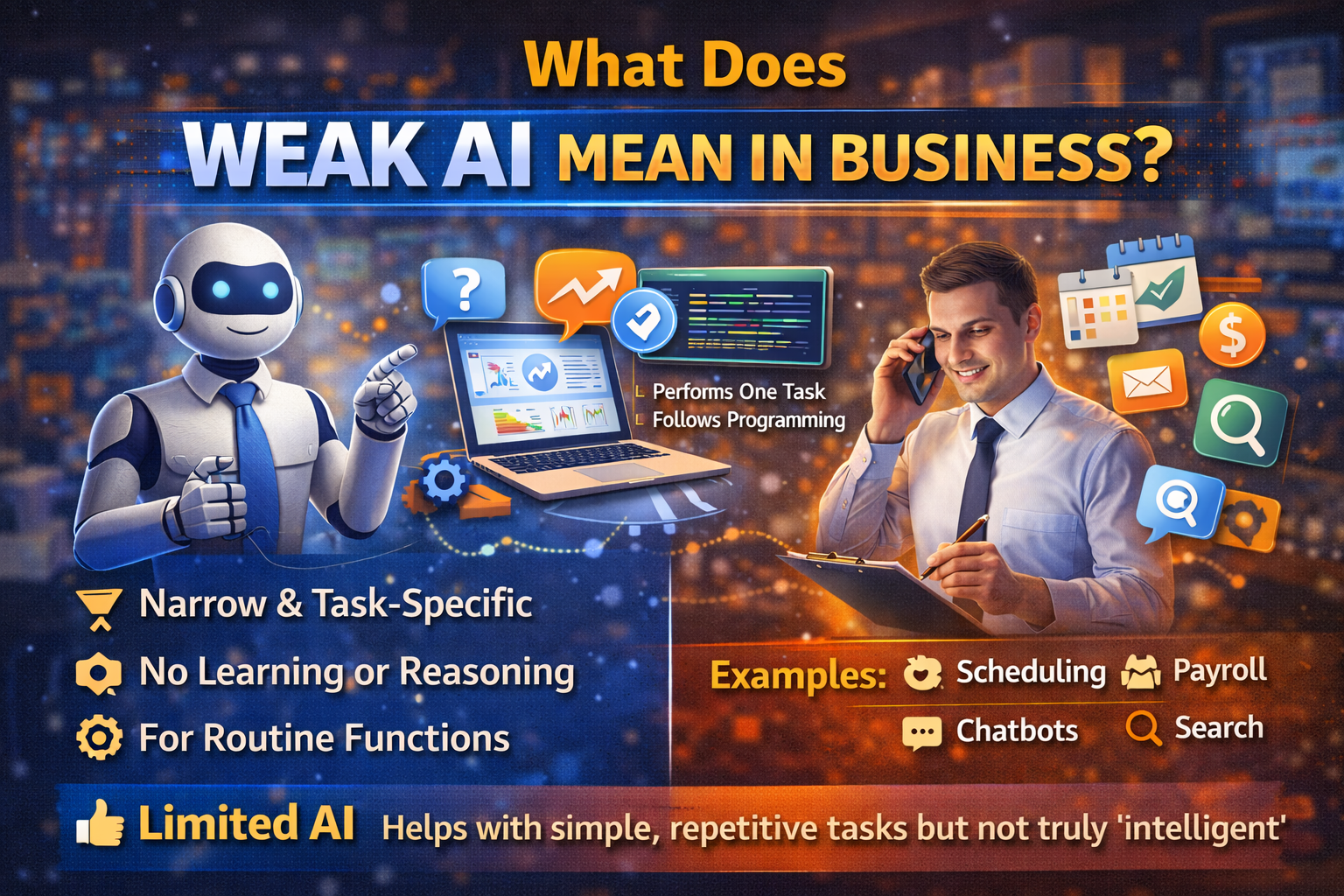
Before exploring its business implications, it’s essential to define weak AI clearly. Often contrasted with “strong AI” or Artificial General Intelligence (AGI), weak AI – more accurately termed “Narrow AI” – refers to AI systems designed and trained for a particular task. These systems excel at their specific functions but lack genuine understanding, consciousness, or the ability to perform outside their programmed domain. Think of it as a highly specialized tool rather than a general-purpose intellect.
In 2026, weak AI is not a futuristic concept; it’s already deeply embedded in our daily lives and business operations. From the voice assistant on your smartphone to the fraud detection systems used by banks, these are all examples of weak AI at work. They operate based on algorithms, vast datasets, and pre-programmed rules to achieve a specific outcome.
The Spectrum of AI: Weak vs. Strong
To truly grasp what does weak AI mean in business, it’s helpful to understand where it sits on the broader AI spectrum:
- Weak AI (Narrow AI):
- Focus: Performs a single task or a narrow set of tasks.
- Cognition: Simulates intelligent behavior; no genuine consciousness or self-awareness.
- Learning: Learns from data to improve performance within its defined scope.
- Examples: Recommendation systems, chatbots, spam filters, image recognition, predictive maintenance.
- Strong AI (Artificial General Intelligence – AGI):
- Focus: Hypothetical AI with human-like cognitive abilities across a wide range of tasks.
- Cognition: Possesses genuine understanding, consciousness, and self-awareness.
- Learning: Can learn and apply intelligence to any intellectual task a human can.
- Examples: Remains theoretical; not yet achieved.
- Superintelligence:
- Focus: Hypothetical AI that surpasses human intelligence in virtually every field, including scientific creativity, general wisdom, and social skills.
- Cognition: Far exceeds human capabilities.
- Learning: Unfathomable potential for learning and self-improvement.
- Examples: Also theoretical; an even more advanced form of AGI.
For businesses in 2026, the focus is almost exclusively on weak AI. It’s the practical, deployable, and value-generating form of AI available today.
Practical Applications of Weak AI in Business
The real power of weak AI in the business world lies in its versatility and ability to automate, analyze, and optimize specific functions. Businesses worldwide are already reaping significant benefits by integrating these specialized AI tools.
Enhancing Customer Service with AI Chatbots and Virtual Assistants
One of the most visible applications of weak AI is in customer service. AI-powered chatbots and virtual assistants can handle a high volume of routine inquiries, answer frequently asked questions, and even guide customers through processes like password resets or order tracking. This frees up human agents to focus on more complex, high-value interactions.
- 24/7 Availability: Customers can get support anytime, anywhere.
- Instant Responses: No waiting times for common queries.
- Cost Reduction: Lowers operational costs associated with call centers.
- Improved CX: Provides consistent and quick service, enhancing customer satisfaction.
“In 2026, a business without some form of AI-driven customer support is increasingly at a disadvantage, struggling to meet customer expectations for speed and availability.”
Streamlining Operations Through Automation
Weak AI is a cornerstone of operational efficiency. From Robotic Process Automation (RPA) that automates repetitive digital tasks to AI-powered scheduling and inventory management systems, its impact is profound.
- Manufacturing: Predictive maintenance systems use AI to analyze sensor data from machinery, identifying potential failures before they occur. This minimizes downtime and extends equipment life.
- Logistics: AI optimizes delivery routes, manages warehouse operations, and predicts demand fluctuations, leading to more efficient supply chains.
- Administrative Tasks: AI can automate data entry, document processing, and email sorting, reducing human error and freeing employees for more strategic work.
For deeper insights into how AI can transform your processes, explore this resource on how AI can optimize business processes for maximum efficiency.
Driving Smarter Marketing and Sales
Weak AI provides powerful tools for understanding customer behavior, personalizing experiences, and optimizing sales strategies.
- Recommendation Engines: Platforms like Netflix, Amazon, and Spotify use weak AI to suggest products or content based on past user behavior, significantly increasing engagement and sales.
- Personalized Marketing: AI analyzes customer data to create highly targeted ad campaigns and personalized email marketing content.
- Lead Scoring: AI models can identify which leads are most likely to convert, allowing sales teams to prioritize their efforts.
- Predictive Analytics: AI can forecast market trends, consumer demand, and sales performance, enabling businesses to make proactive decisions.
Enhancing Data Analysis and Business Intelligence
The ability of weak AI to process and interpret vast amounts of data far beyond human capability is invaluable for business intelligence.
- Pattern Recognition: AI can identify subtle patterns and correlations in data that humans might miss, leading to new insights.
- Fraud Detection: Financial institutions use AI to detect unusual transaction patterns that might indicate fraudulent activity.
- Risk Assessment: AI models help in assessing credit risk, insurance claims, and investment opportunities with greater accuracy.
- Market Research: AI can analyze social media sentiment, news articles, and online reviews to provide real-time market insights.
Cybersecurity and Security Management
In an increasingly digital world, weak AI plays a critical role in protecting business assets.
- Threat Detection: AI systems monitor network traffic and user behavior for anomalies that could indicate a cyberattack.
- Malware Analysis: AI can quickly analyze new malware strains and develop countermeasures.
- Access Control: AI-powered facial recognition or behavioral biometrics enhance physical and digital security.
The Business Advantages of Embracing Weak AI in 2026
For businesses navigating the competitive landscape of 2026, ignoring weak AI is no longer an option. Its adoption offers distinct strategic advantages that can lead to significant growth and sustainability.
Increased Efficiency and Productivity 🚀
By automating repetitive, rules-based tasks, weak AI frees human employees from mundane work, allowing them to focus on creative problem-solving, strategic planning, and activities that require emotional intelligence or complex reasoning. This leads to a substantial boost in overall organizational productivity. For a broader perspective, consider the future impact of AI on business and how it’s shaping operational efficiency.
Cost Reduction 💰
The automation capabilities of weak AI directly translate into cost savings. Reduced labor costs for routine tasks, minimized errors, optimized resource allocation, and predictive maintenance all contribute to a healthier bottom line. For instance, an AI-powered inventory system can significantly reduce holding costs and waste.
Improved Decision-Making 🧠
Weak AI’s ability to process and analyze massive datasets rapidly provides businesses with data-driven insights that inform better decisions. This goes beyond simple reporting, offering predictive capabilities and identifying opportunities or risks that might otherwise go unnoticed.
Enhanced Customer Experience (CX) ❤️
From personalized recommendations to 24/7 customer support, weak AI empowers businesses to deliver a more responsive, tailored, and satisfying customer journey. This builds loyalty and strengthens brand reputation.
Competitive Edge 🏆
Businesses that effectively integrate weak AI gain a significant competitive advantage. They can innovate faster, operate more efficiently, understand their customers better, and respond to market changes with greater agility than competitors who lag in AI adoption. Exploring how AI is transforming different business sectors can highlight this competitive drive.
Scalability and Growth 🌱
Weak AI systems can handle increasing workloads without a proportional increase in human resources. This scalability allows businesses to grow and expand operations more easily, adapting to new demands without significant overhead.
Challenges and Considerations for Implementing Weak AI
While the benefits are clear, successfully integrating weak AI into business operations isn’t without its challenges. Organizations must be prepared to address several key considerations.
Data Quality and Availability 📊
Weak AI systems are only as good as the data they are trained on. Poor quality, biased, or insufficient data will lead to inaccurate or unreliable AI performance. Businesses must invest in robust data collection, cleaning, and management strategies.
Integration Complexity 🔗
Integrating new AI systems with existing legacy infrastructure can be complex and require significant technical expertise. Ensuring seamless data flow and compatibility between systems is crucial. A strategic approach to integration can be found in a step-by-step guide to integrating AI into your business.
Talent Gap 🧑💻
There’s a growing demand for skilled AI professionals, including data scientists, machine learning engineers, and AI strategists. Businesses may struggle to find and retain the talent needed to develop, implement, and maintain AI solutions.
Ethical Concerns and Bias ⚖️
AI systems can perpetuate or even amplify existing biases present in their training data. This can lead to unfair or discriminatory outcomes, particularly in areas like hiring, lending, or law enforcement. Businesses must proactively address ethical considerations and implement fairness safeguards.
Cost of Implementation and Maintenance 💸
While weak AI can lead to cost savings, the initial investment in technology, infrastructure, talent, and ongoing maintenance can be substantial. Businesses need a clear ROI justification and budget allocation.
Resistance to Change 😟
Employees may be apprehensive about AI adoption due to fears of job displacement or the need to learn new skills. Effective change management, clear communication, and reskilling programs are essential to ensure a smooth transition and maximize adoption.
The Future Trajectory of Weak AI in Business for 2026 and Beyond
Looking ahead in 2026, the capabilities of weak AI are continuously expanding. Advancements in machine learning, natural language processing (NLP), and computer vision are making these specialized systems even more powerful and versatile.
We can expect:
- More Sophisticated Personalization: AI will deliver even more granular and predictive personalized experiences across all customer touchpoints.
- Hyper-Automation: The combination of weak AI, RPA, and other automation technologies will lead to end-to-end automation of complex business processes.
- Enhanced Human-AI Collaboration: AI will increasingly serve as an intelligent assistant, augmenting human capabilities rather than replacing them entirely, fostering new forms of partnership in the workplace. This approach is key to leveraging AI to improve your business.
- AI for Sustainability: Weak AI will play a growing role in optimizing energy consumption, managing waste, and developing sustainable practices across industries.
- Democratization of AI: Cloud-based AI services and low-code/no-code platforms will make AI tools more accessible to businesses of all sizes, lowering the barrier to entry.
Businesses that stay abreast of these developments and strategically integrate weak AI will be best positioned for success in the evolving digital economy.
Conclusion: Harnessing the Practical Power of Weak AI
Understanding what does weak AI mean in business is paramount for any organization striving for success in 2026. Far from the sensationalized visions of general AI, weak AI represents a tangible, practical, and incredibly powerful suite of tools designed to perform specific tasks with high efficiency and accuracy. It is the engine driving automation, personalized customer experiences, data-driven insights, and operational excellence across virtually every industry.
By strategically implementing weak AI, businesses can:
- Boost Efficiency: Automate routine tasks, optimize processes, and free up human potential for higher-value work.
- Reduce Costs: Lower operational expenses through automation, predictive maintenance, and optimized resource allocation.
- Enhance Customer Satisfaction: Deliver personalized, responsive, and consistent experiences that build loyalty.
- Improve Decision-Making: Leverage vast datasets to gain actionable insights and make informed strategic choices.
- Gain a Competitive Edge: Innovate faster, adapt more quickly, and outperform competitors in an increasingly AI-driven marketplace.
However, success with weak AI isn’t automatic. It requires a clear strategy, investment in quality data and infrastructure, ethical considerations, and a commitment to integrating these technologies thoughtfully. The future of business in 2026 is inextricably linked to the intelligent adoption of weak AI – not as a replacement for human ingenuity, but as a powerful amplifier of it. Embrace its capabilities, and unlock new frontiers of innovation and growth for your organization.
References
[1] Russell, Stuart J., and Peter Norvig. Artificial Intelligence: A Modern Approach. 4th ed., Pearson, 2021.
[2] Davenport, Thomas H., and R. Ronanki. “Artificial Intelligence for the Real World.” Harvard Business Review, January–February 2018, pp. 108–116.
Key Takeaways
- Weak AI, also known as Narrow AI, is designed for specific tasks and operates within predefined parameters, unlike hypothetical general AI.
- It powers many everyday business tools from chatbots and recommendation engines to predictive analytics and automation software.
- Businesses leverage weak AI to enhance efficiency, reduce costs, improve customer experience, and gain data-driven insights.
- Successful integration requires clear objectives, quality data, ethical considerations, and a focus on augmenting human capabilities.
- Ignoring weak AI in 2026 can lead to competitive disadvantages, as it’s becoming a fundamental component of modern operational strategies.
Frequently Asked Questions about Weak AI in Business
The primary difference is that weak AI (Narrow AI) is designed to perform a specific, limited task, like playing chess or recognizing faces. Strong AI (Artificial General Intelligence – AGI) is a theoretical concept referring to AI with human-level cognitive abilities across a wide range of tasks, including consciousness and genuine understanding.
In 2026, weak AI benefits businesses by increasing efficiency through automation, reducing operational costs, improving customer experience via chatbots and personalized recommendations, enhancing data analysis for better decision-making, and providing a significant competitive advantage in the market.
Common examples include customer service chatbots, recommendation engines on e-commerce sites, predictive maintenance systems in manufacturing, fraud detection software in finance, personalized marketing tools, and AI-powered data analytics platforms used for business intelligence.
Key challenges include ensuring high-quality and sufficient data for training, managing the complexity of integrating AI with existing systems, addressing the talent gap for AI professionals, mitigating ethical concerns and potential biases in AI algorithms, and managing the initial cost of implementation and potential resistance to change from employees.
How to Implement Weak AI in Your Business Successfully
Define Clear Objectives
Identify specific business problems or opportunities that weak AI can address, such as automating customer service or optimizing logistics. Start with a pilot project to test the waters and learn.
Assess Data Readiness
Evaluate your existing data for quality, quantity, and relevance. Clean, prepare, and potentially augment your data, as AI performance heavily relies on its input. Poor data leads to poor AI.
Choose the Right AI Solution
Select appropriate weak AI technologies (e.g., NLP for chatbots, machine learning for predictive analytics) either off-the-shelf or custom-developed, aligning with your objectives and data capabilities.
Integrate and Pilot
Integrate the AI solution with your existing systems, ensuring smooth data flow and compatibility. Begin with a controlled pilot program to test its effectiveness, iron out issues, and gather initial feedback before a wider rollout.
Scale and Monitor
After a successful pilot, scale the AI solution across relevant departments. Continuously monitor its performance, update models with new data, and retrain regularly to maintain accuracy and adapt to changing business needs and market conditions.
Key AI Terminology for Business
- Weak AI (Narrow AI)
- Artificial intelligence designed and trained for a particular, specific task or a narrow set of tasks. It operates within predefined parameters and does not possess genuine consciousness or general intelligence. This is the predominant form of AI used in business in 2026.
- Strong AI (Artificial General Intelligence – AGI)
- A hypothetical type of AI that possesses human-like cognitive abilities, including consciousness, self-awareness, and the ability to apply intelligence to any intellectual task, similar to a human being. It is not yet a reality in 2026.
- Machine Learning (ML)
- A subset of AI that enables systems to automatically learn and improve from experience without being explicitly programmed. ML algorithms are trained on data to identify patterns and make predictions or decisions.
- Natural Language Processing (NLP)
- A branch of AI that gives computers the ability to understand, interpret, and generate human language. NLP is crucial for applications like chatbots, sentiment analysis, and voice assistants.
- Robotic Process Automation (RPA)
- Technology that uses software robots (bots) to automate repetitive, rules-based tasks in business processes, often mimicking human interaction with digital systems. RPA frequently works in conjunction with weak AI.

 By
By
 By
By